Just one more game. Sometimes I have a win streak, sometimes I lose three games in a row, close the browser tab swearing to never play again this stupid game, then one hour later I play again.
I even participate in tournaments since I joined a chess club called “Capivaras da Serra” which means “Capybaras of the Highlands”, and my current FIDE rating is 1700.
The game was introduced to me when I was 10 years old, at my school by the gym teacher. At that time, we just learned how the pieces move. She even gave us a wrong instruction, saying the king could move 2 squares to capture a piece (until this day I don’t know where she got that from). Anyway, I wasn’t playing seriously, it was just school stuff.
Almost 15 years later, a friend of mine was playing on chess.com while on a lunch break. I still remembered how to play, then I created an account to play with him. From that day on, I never stopped playing. My rating was 700 on rapid.
For those who don’t know, chess is divided between time controls. You have:
- Bullet: 1 min to 2 min games for each side
- Blitz: 3 min to 5 min
- Rapid: 10 min to 20 min
- Classical: 30 min onwards
- Correspondence: Basically no time limit.
This is a rough estimation, FIDE has the proper rules for over-the-board games, but sites such as lichess.com and chess.com kind of have a similar but slightly different set of time controls.
The ability to play chess is the sign of a gentleman. The ability to play chess well is the sign of a wasted life.
As in every online competitive game, I wanted to get better at it. I wanted to have a better rating. So I started watching videos on how to improve, and I probably have wasted more than one thousand hours playing and studying. My rating climbed only from 700 to 1200 on chess.com, so I’m still mediocre. Like, it is astonishing how many hours and effort you have to pour into a game just to be average. This game is nuts.
Chess also has a cool history, from the romance era to Paul Morphy, Capablanca, then the Cold War rivalry with many legends such as Mikhail Tal, Anatoly Karpov, Mikhail Botvinnik, Garry Kasparov, Bobby Fischer, and the list goes on. Those people basically shaped the game by creating openings, studies, and books.
But then, in 1997, the chess engine Deep Blue won against Garry Kasparov, the first time a computer consistently won against a world champion, and chess changed after that. Nowadays, we have chess engines such as Stockfish, operating on a scale far beyond any human capability. And the current era of chess players was deeply inspired by chess engine studies.
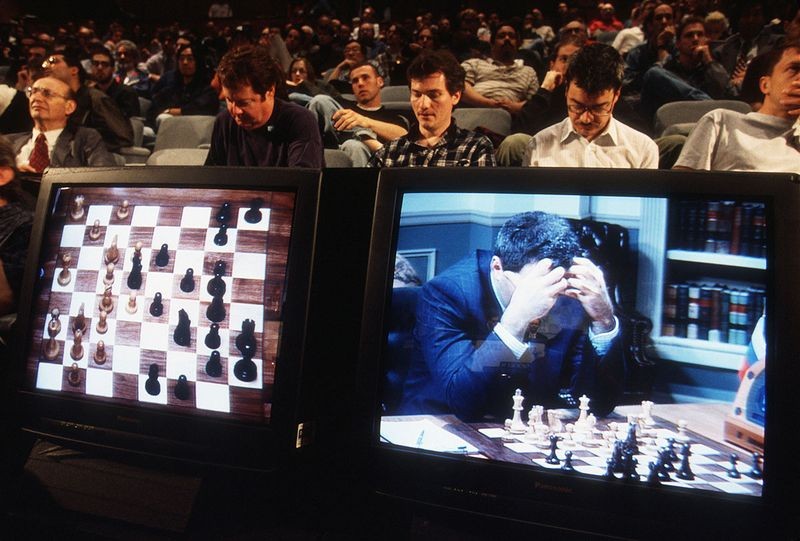
Kasparov vs. Deep Blue, May 1997
And modern players are beasts: Magnus Carlsen, Hikaru Nakamura, Praggnanandhaa, and countless others. They are so strong that they even have a special unofficial category for them called “Super GMs.”
We also have chess as entertainment. Like, since the pandemic in 2022, chess grew in popularity a lot. If you search on YouTube, there are a lot of chess streamers hitting some impressive view numbers. And that is another trap; I thought that if I kept watching speedruns/slowruns I’d learn a lot, but what I have learned so far is that entertainment != improvement.
So, after many hours of lessons and videos, here is my cheat sheet of rules for people looking to improve at chess and do not want to lose the same amount of time I lost.
Strategy
Early Game
- Control the center
- Develop the pieces
- Castle
Middle Game
- Attack Weaknesses
- Improve Pieces
- Prophylaxis
Endgame
- Attack Pawns
- Make Passed Pawn
- Active King
After every opponent move, follow the B.A.D. set of questions:
- Blunder: Did my opponent just threaten or leave hanging?
- Attacks: What pieces/pawns are being attacked now? What can I attack?
- Defenses: What is defending the important pieces/squares, and has that defense changed?
Another important thing is, learn one or two good openings for white, one response for e4 and one response for d4 as black and stick to those openings. The more you play then and review your games, the more you learn and feel comfortable under those structures.